Picture a Monday.
A client forwards you a screenshot. Someone on their team asked ChatGPT for the best vendor in their category. A competitor got named. Your client did not.
Under the screenshot: “Can you check this? And can we keep an eye on it?”
You have forty minutes before the call. What do you open?
Most “best AI visibility tools” lists answer with a ranking of logos. That is not how agencies buy. Agencies buy relief from specific, expensive problems: a client who wants proof, a finance lead who wants revenue, a pitch to win, a bill that grows faster than the retainer.
So this article works in the other order.
- The squeeze: the data on what is happening to agencies right now.
- Eight pain points: what each looks like on a Monday, and what it demands of a tool.
- How these tools really work: the part vendors skip, and the part that decides whether you can trust them.
- Thirteen options, read against those pain points.
- What to use when, with the money worked out.
Part 1: The squeeze, in numbers
Clients are asking. In the 2026 AgencyAnalytics Marketing Agency Benchmarks Report (494 agency professionals, surveyed February to April 2026):
- 66% report rising client demand for AEO and SEO for AI search. It is the #1 new service clients request, ahead of performance ads (55%) and short-form video (51%).
- 64% name Google’s AI Overviews their top industry concern. 59% say AI and LLM search is disrupting traditional SEO.
- 59% are shifting SEO strategy to compensate for reduced visibility. 41% say measuring ROI got harder.
Numbers in a list are easy to nod along to and forget. Here is the same survey drawn out, with the part that matters for your Monday picked out in black.
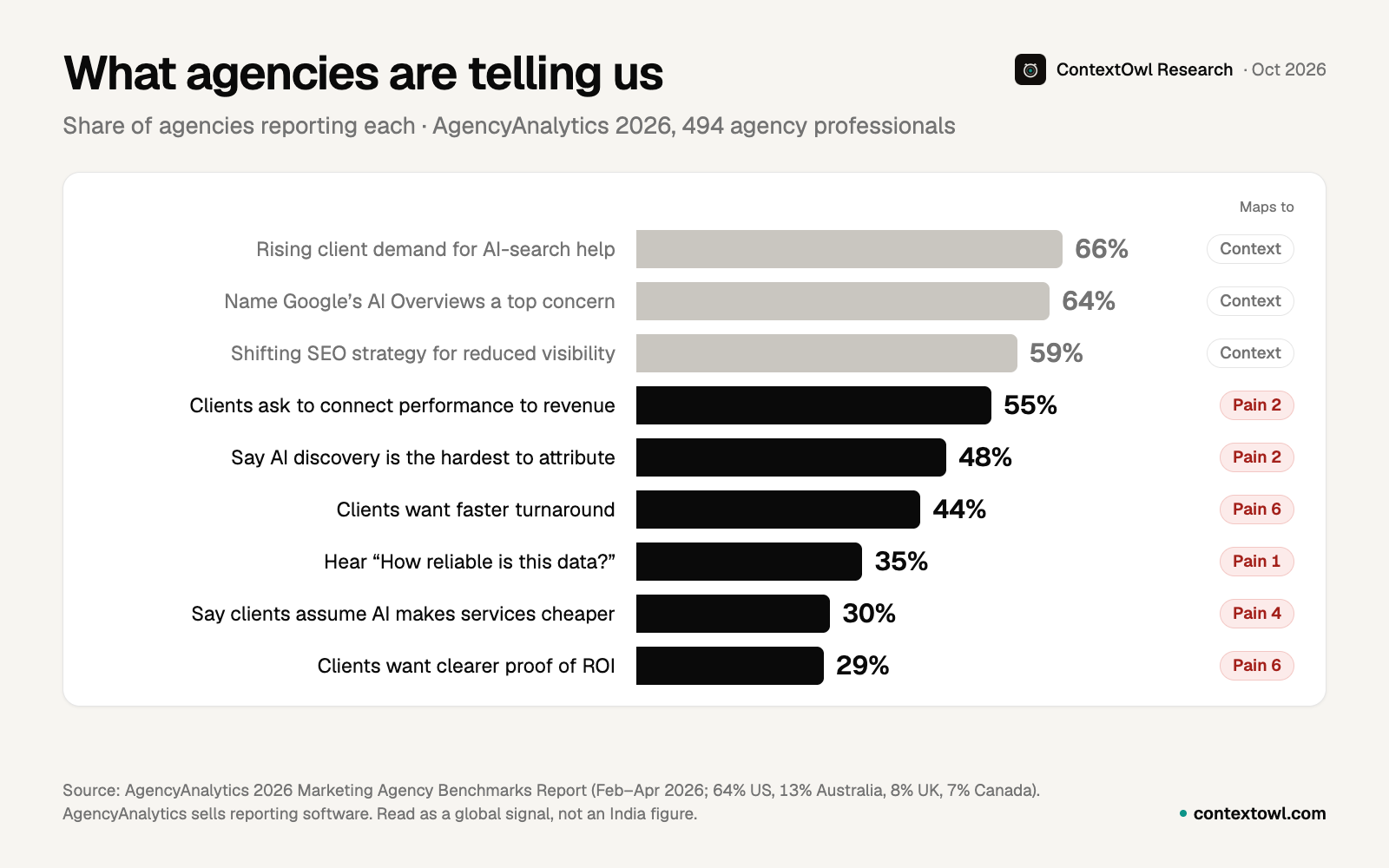
Figure 1. What agencies report, as a share of agencies. Source: AgencyAnalytics 2026 Marketing Agency Benchmarks Report, 494 agency professionals.
Notice the split. The three grey bars at the top are the weather: demand is up, Google’s AI Overviews worry almost two agencies in three, and strategies are shifting. The black bars are where it hurts. Clients asking you to tie the work to revenue (55%). Agencies unable to say where AI discovery fits in attribution (48%). Clients asking whether the data can even be trusted (35%). Each black bar becomes a pain point in Part 2.
The clicks are going. SparkToro’s analysis of Similarweb clickstream data found 68.01% of US Google searches ended without a click in January to April 2026, up from 60.45% in 2024 (different data panels, so read it as a direction). The same study says AI tools send under 1% of all traffic out. Separately, a Pew Research Center study of 900 US adults found people clicked a traditional result in 8% of visits with an AI summary, against 15% without.
Buyers are asking. OpenAI’s CEO said ChatGPT had 100 million weekly users in India in February 2026, its second-largest base after the US, with students the biggest group. Google’s AI Mode reached all users in India in July 2025, added Hindi in September 2025 and seven more Indian languages in October 2025.
Three studies, three different panels, one direction of travel. Side by side, they make the case faster than any paragraph.
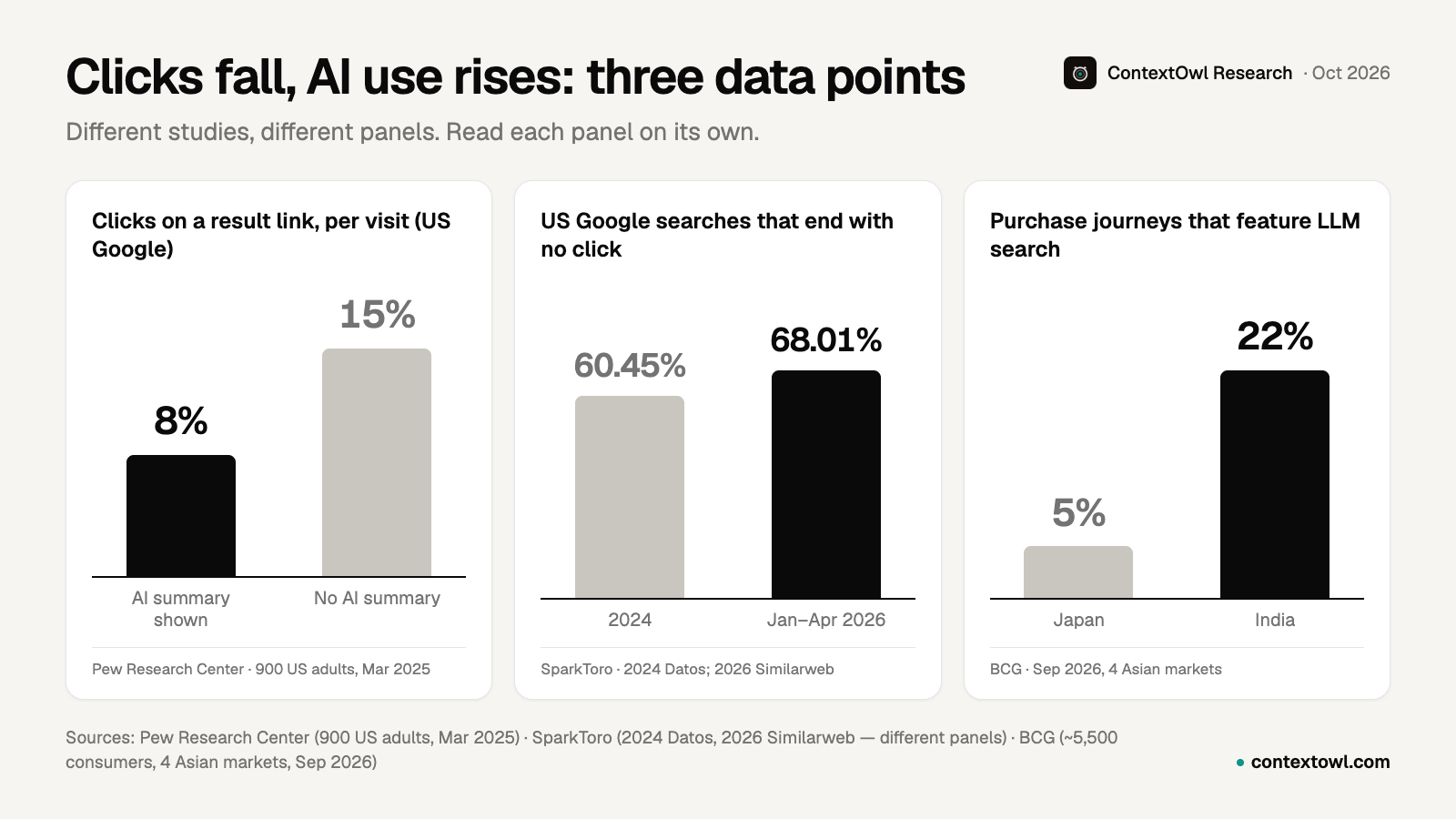
Figure 2. Three data points on three different panels. Sources: Pew Research Center (900 US adults, March 2025); SparkToro (2024 Datos panel, 2026 Similarweb panel); BCG (about 5,500 consumers in four Asian markets, September 2026).
An editor owes you two cautions. These panels measure different things, so please do not subtract one from another. And the India bar is reach, not revenue: LLM search shows up in roughly one in five Indian purchase journeys in BCG’s sample, against about one in twenty in Japan. That is not a takeover. It is more than enough to change where an agency should be looking first.
Budgets are following. A Conductor survey of 250+ enterprise executives found 94% plan to raise AEO and GEO investment in 2026, after an average 12% of digital budgets in 2025.
Read these with care. AgencyAnalytics sells reporting software and launched its own AI Tracker in July 2026. Its respondents are 64% US, 13% Australia, 8% UK and 7% Canada, and nearly half run agencies of 1 to 10 people. Conductor sells an AEO platform. SparkToro’s panel is US-only. These are directional signals. We could not find an India-specific agency survey on AI visibility. If you have seen one, send it our way.
Part 2: Eight pain points, and what each demands of a tool
Pain point 1: “A screenshot isn’t proof”
A client asks what ChatGPT says about them. You paste an answer. They ask if it is always like that. You do not know.
The data says clients are probing exactly here. 35% of agencies hear “How reliable is this data?” from clients. 97% rate accurate reporting as important for retention, and 76% as extremely important. What clients value most in a report is clear visuals (84%). AI-generated summaries came last, at 9%.
What to demand: the real answers and the sources behind them, shown clearly. A score alone is an opinion.
Pain point 2: “Show me it’s working”
The #1 client question in the AgencyAnalytics data is “Can you clearly connect marketing performance to revenue?” (55%). Meanwhile 48% of agencies call tracking people who discover brands through AI tools their hardest attribution problem, and 47% cannot attribute multi-session journeys.
Add the traffic numbers above and you can see the squeeze: the channel that is growing sends almost no clicks.
There is a fair counter-view. Seer Interactive argued in January 2026 that AI visibility on its own is a vanity metric, because answers are not repeatable and personalisation muddies them.
What to demand: honest presence metrics, and no promise of revenue. Pair visibility with first-party proxies such as sales-call mentions and branded search. Any tool that implies a revenue link should show its working.
Pain point 3: “The numbers change every run”
This one is the quiet trust problem. SparkToro and Gumshoe.ai had about 600 volunteers run 12 prompts nearly 3,000 times across ChatGPT, Claude and Google’s AI. There was under a 1-in-100 chance of the same brand list twice. In its Office Hours session on whether AI visibility can be tracked, SparkToro argued that visibility percentage across many prompts and many runs is the meaningful measure, and that an individual “AI rank” is not a stable thing to track. It also found that real people word the same intent very differently, which makes any fixed prompt list an approximation.
What to demand: run counts, prompts you can edit, and a visibility rate in place of a rank.
Pain point 4: “The bill grows faster than the retainer”
Look at how many clients agencies carry. In the AgencyAnalytics sample, 25% serve 6 to 15 clients, 20% serve 16 to 25, 17% serve 26 to 50, and 31% serve more than 50. Now look at how tools price: per prompt, per domain, per client workspace, per project, or per report. Those models behave very differently as your list grows. 13% of agency leaders named “increasing profit margins despite rising costs” as their biggest operational challenge, and 30% say clients now perceive agency services as cheaper because they assume AI cuts costs.
Here is the distribution behind that sentence, because the shape matters more than any one bar.
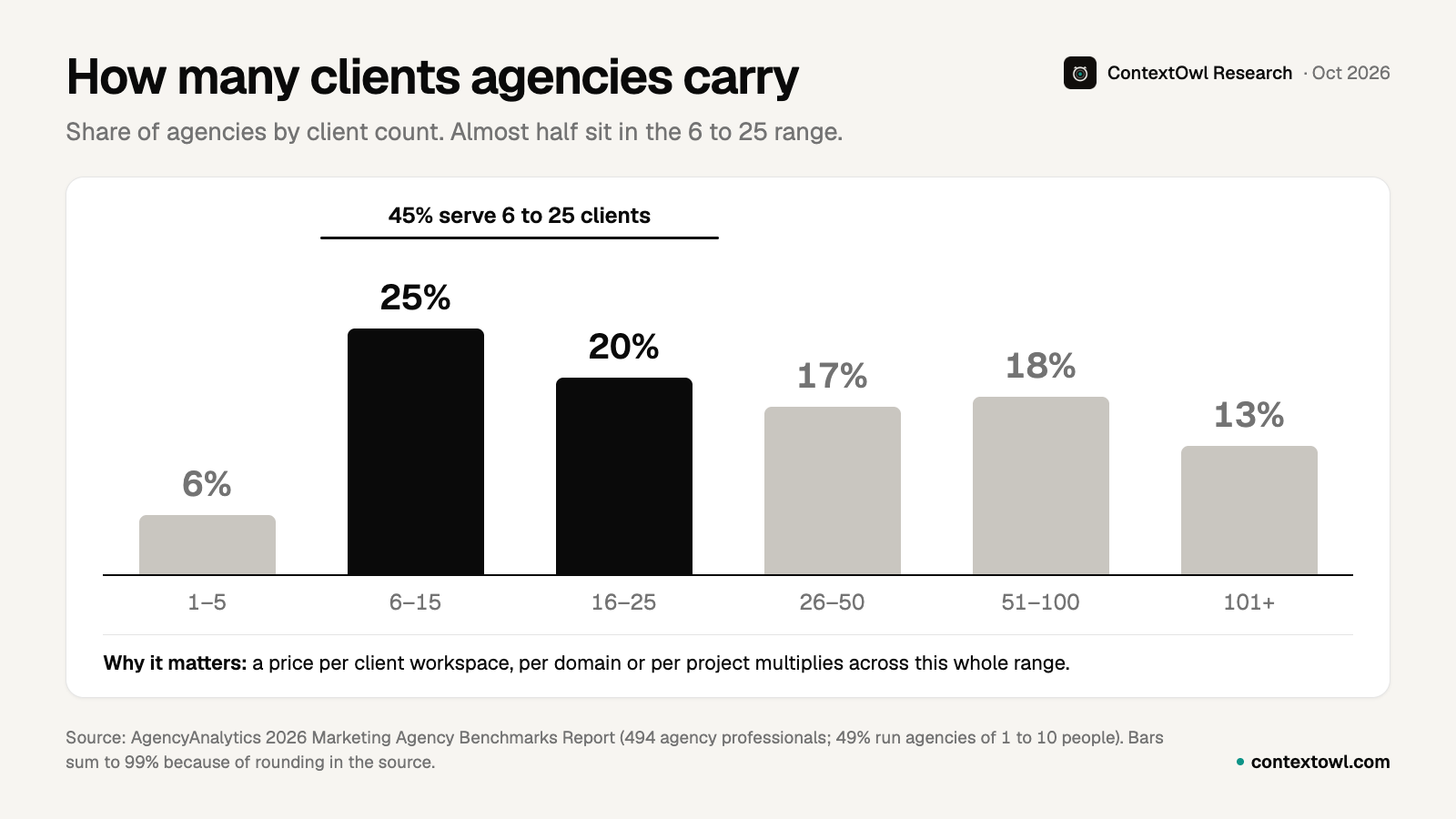
Figure 3. Share of agencies by number of clients. Source: AgencyAnalytics 2026 Marketing Agency Benchmarks Report. Bars sum to 99% because of rounding in the source.
Almost half of agencies, 45%, carry between 6 and 25 clients. That is exactly the range where a per-workspace, per-domain or per-project price quietly doubles and triples. If a tool charges you for every client you add, your margin becomes a function of your client list rather than your skill.
What to demand: a pricing unit that matches how you bill. We work out an example in Part 5.
Pain point 5: “Win the work before you do the work”
Acquiring new clients is the top operational challenge for the fourth year running (30%). 47% of agencies win half their pitches or fewer. What wins? Industry expertise (59%), clear ROI (46%), case studies (46%), and, for 22%, clear reporting and benchmark context. A prospect who sees a competitor named in an AI answer where they are missing pays attention. A slide about “the future of search” does not.
What to demand: a free or cheap prospect audit that does not eat your client quota.
Pain point 6: “Faster, cheaper, and show your working”
44% of agencies say clients want faster turnaround. 36% want proactive insights. 29% want clearer proof of ROI and 25% want more transparency. And while static reports are still the top format (35%), 1:1 meetings tie with them. Clients want the conversation as well as the PDF.
What to demand: output you can brand as your own and walk a client through. A dashboard login you hand over is not the same thing.
Pain point 7: “Findings with no scope”
“We should look at AI” does not fill a quarter. A ranked list of fixes does. That is the difference between a monitoring dashboard and a retainer. It also matters internally: 15% of agencies cite upskilling their team as a top team challenge, and 58% have increased human review of AI-assisted work.
What to demand: a ranked fix list you can turn into a statement of work.
Pain point 8: “Built for someone else’s market”
Most tools price in dollars or euros and were designed around US search. Check the fine print. Semrush’s help page says its prompt tracking is currently available for prompts in the United States. Hindi and Hinglish tracking is rare: of the tools we checked, only one directory listing (Citedar) claims it. And rupee billing with GST invoices is offered by a handful of tools, not the leaders.
What to demand: location and language you can verify, an India-region test before you commit, and billing your finance team can book.
The eight, on one page
If you keep one thing from this section, keep this page. Print it, pin it above the monitor and take it into every vendor demo.
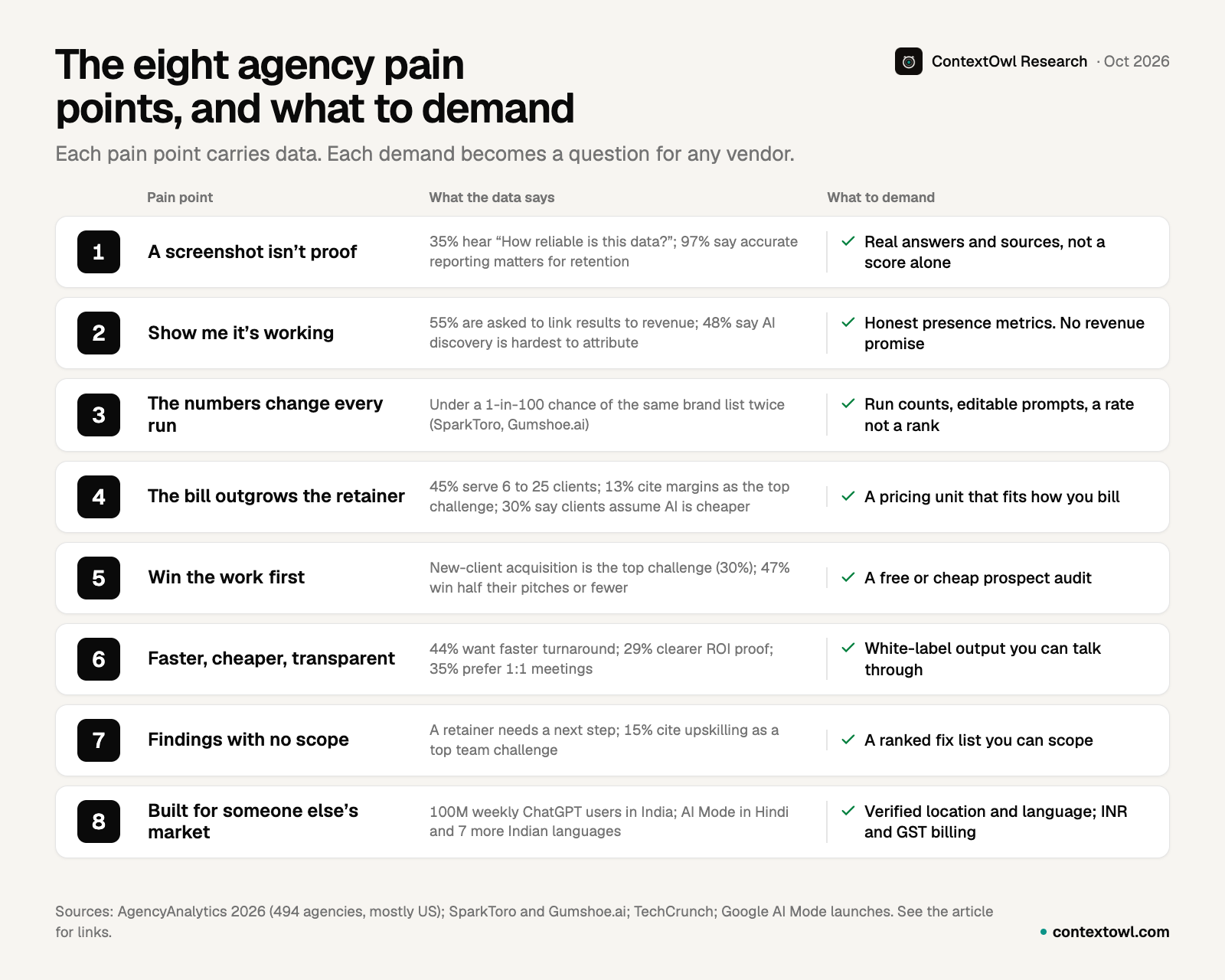
Figure 4. The eight pain points, what the data says about each, and what to demand. Sources: AgencyAnalytics 2026 (494 agencies, mostly US); SparkToro and Gumshoe.ai; TechCrunch; Google AI Mode launches.
Look at the right-hand column. Those are eight things you are entitled to ask for, in plain words. A vendor who flinches at three or more of them has told you something before the demo even starts.
Part 3: How these tools really work, and why they disagree
You can skip this section. Do not. It decides which numbers you can show a client.
Every tool here does roughly the same thing. It sends a set of prompts to an AI engine, reads the answers, and records whether your brand was named, cited or recommended. The differences are in four choices.
1. Whose prompts? Many tools generate prompts with AI, from your website or category. SparkToro’s Rand Fishkin has argued, on a podcast, that such synthetic prompts differ from how real people ask, and that tools should be judged on how many prompts they run and how often.
2. How many runs? One run is a sample. Repeated runs let you report a rate. Ask what the run count is behind every number.
3. Which surface? Some tools call the engine’s API. Some automate the real consumer interface. These can differ. A Promptwatch study found 84% of prompts returned sources in the ChatGPT interface against 26% via the API. A Paprik.ai test of 35 prompts over 10 days found the API without web search surfaced 84% fewer brands. Both studies were run by vendors with a stake in the answer, so treat them as a warning, not a verdict. Peec AI says it collects data by browser automation of the real interfaces rather than the API, and Ahrefs says Brand Radar runs its prompts through the public web interfaces of the chatbots, as Trakkr summarises from Peec’s documentation.
4. Score or answers? Some tools show a single number. Better ones show the answers and sources underneath.
The second choice, how many runs, deserves a picture of its own. It quietly decides how much you are allowed to claim.
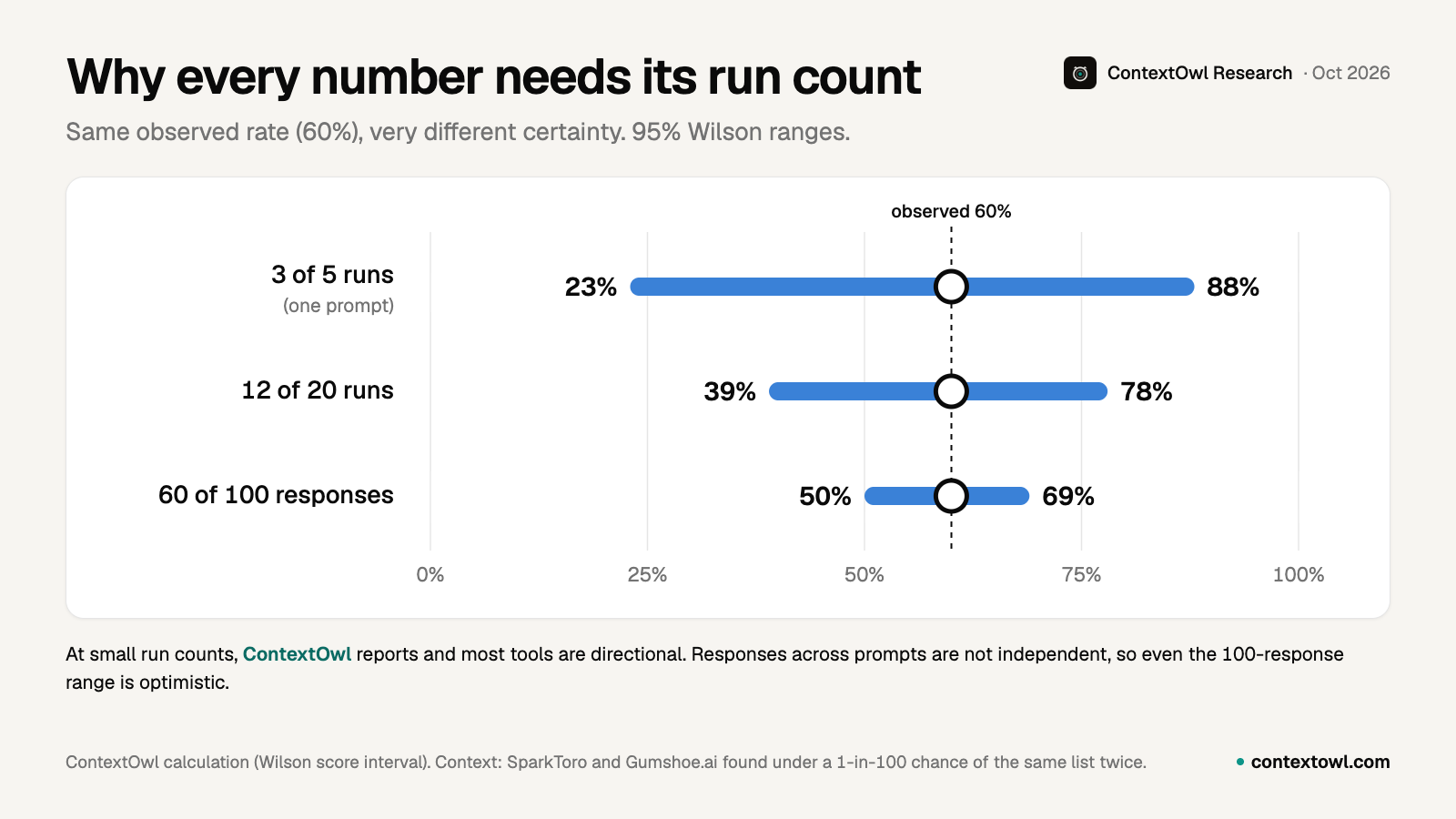
Figure 5. The same observed rate, 60%, over three different run counts, with 95% Wilson ranges. ContextOwl calculation. Context: SparkToro and Gumshoe.ai found under a 1-in-100 chance of the same brand list twice.
Say a brand appears in three of five runs of one prompt. The honest range for its true rate is roughly 23% to 88%, which is nearly the whole map. Over 100 responses it narrows to 50% to 69%, and since responses are not independent, even that is generous. This is why this article keeps saying directional, not decimal, and why ContextOwl labels its own reports as snapshots.
Where we stand. ContextOwl asks each engine your prompts through its API or web-search tool, once per engine, with web search switched on, as its FAQ explains. So the API-versus-app caveat applies to us, and a report is a snapshot, not a trend. That is why we call a score a strong read, not a measurement to the decimal.
What no tool can do. No tool sees real user prompts. None can tell you what a specific customer was shown. And none can promise that a fix will lift you, because each engine makes its own call.
Five questions to ask any vendor
- How many times is each prompt run, and what is the run count behind every number?
- Where do the prompts come from, and can I edit them?
- Do you query the real app, or the API? Can you show me a sample answer next to a real one?
- Can I see the actual answers and sources, not just a score?
- What does it cost at ten clients, in my currency, with tax?
Part 4: Thirteen options, read against the pain points
How we chose: tools you can sign up for online from India, with an agency angle, that we could check against the vendor’s own pages. One benchmark site tracks 42 vendors, so this is a shortlist, not a census. Under each tool we give the pain points it speaks to best. That is our judgement, based on what its pages document.
Before the tool-by-tool notes, the map. Thirteen options, two questions.
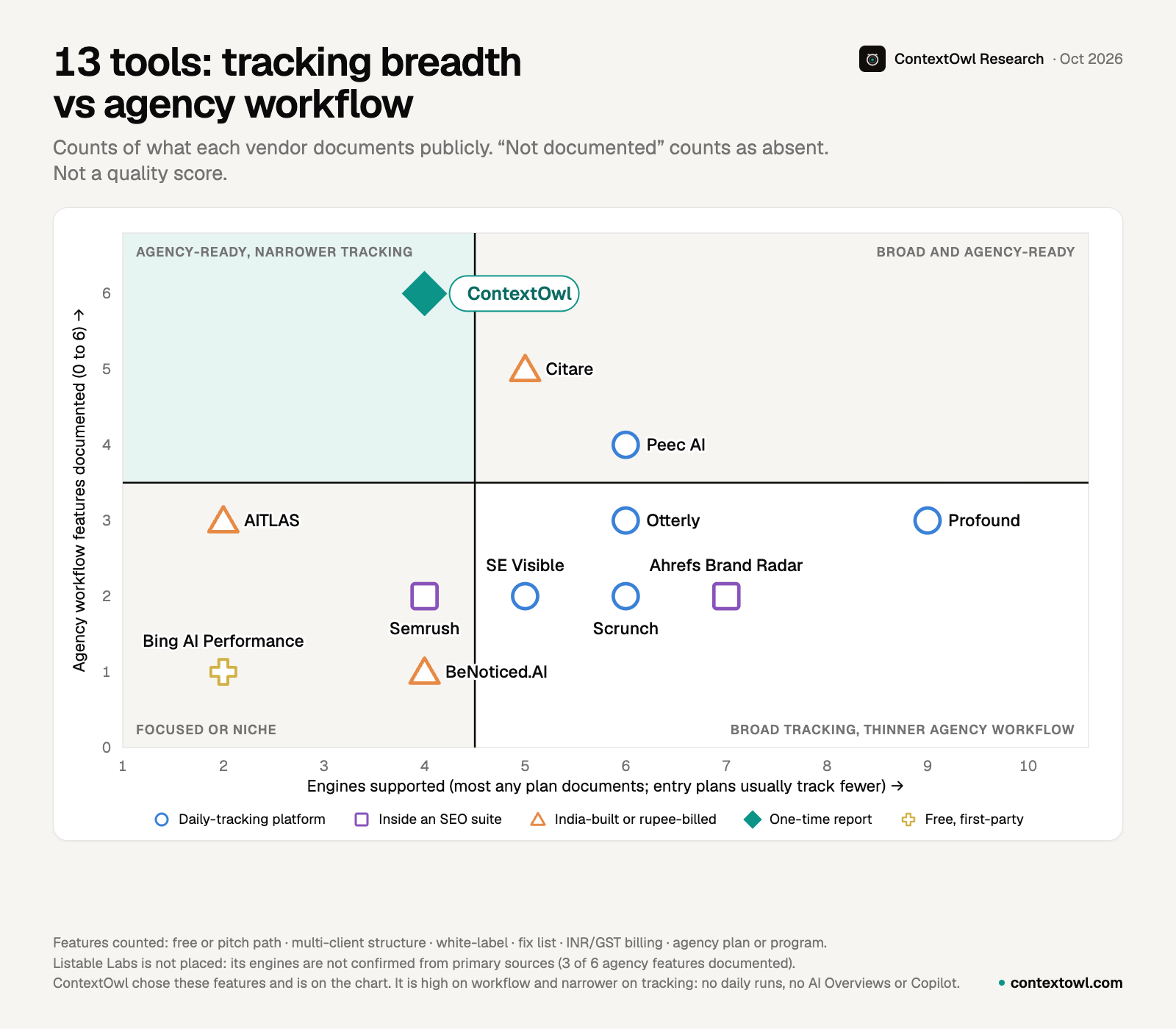
Figure 6. Thirteen tools on two axes. Left to right: engines supported (the most any plan documents). Bottom to top: agency workflow features documented, out of six. Not a quality score.
How to read it. Left to right is breadth: how many AI engines a vendor says it can track on some plan. Bottom to top is agency workflow: how many of six agency-friendly features it documents, namely a free or pitch path, a multi-client structure, white-label output, a fix list, rupee or GST billing and an agency plan.
Two tools land in the top right, broad and agency-ready: Peec AI and Citare. ContextOwl sits top left: strong on agency workflow, narrower on tracking, with four engines and no daily runs. Profound, Otterly, Scrunch, SE Visible and Ahrefs Brand Radar sit bottom right, with wide coverage and a thinner agency story. Semrush, AITLAS, BeNoticed.AI and Bing’s free dashboard sit bottom left, focused or narrow.
Listable Labs is missing, and that is deliberate. We could not confirm its engines from any primary source, and we would rather leave a dot off than guess where to put it.
Charts flatter whoever draws them, so here is the evidence behind every dot.
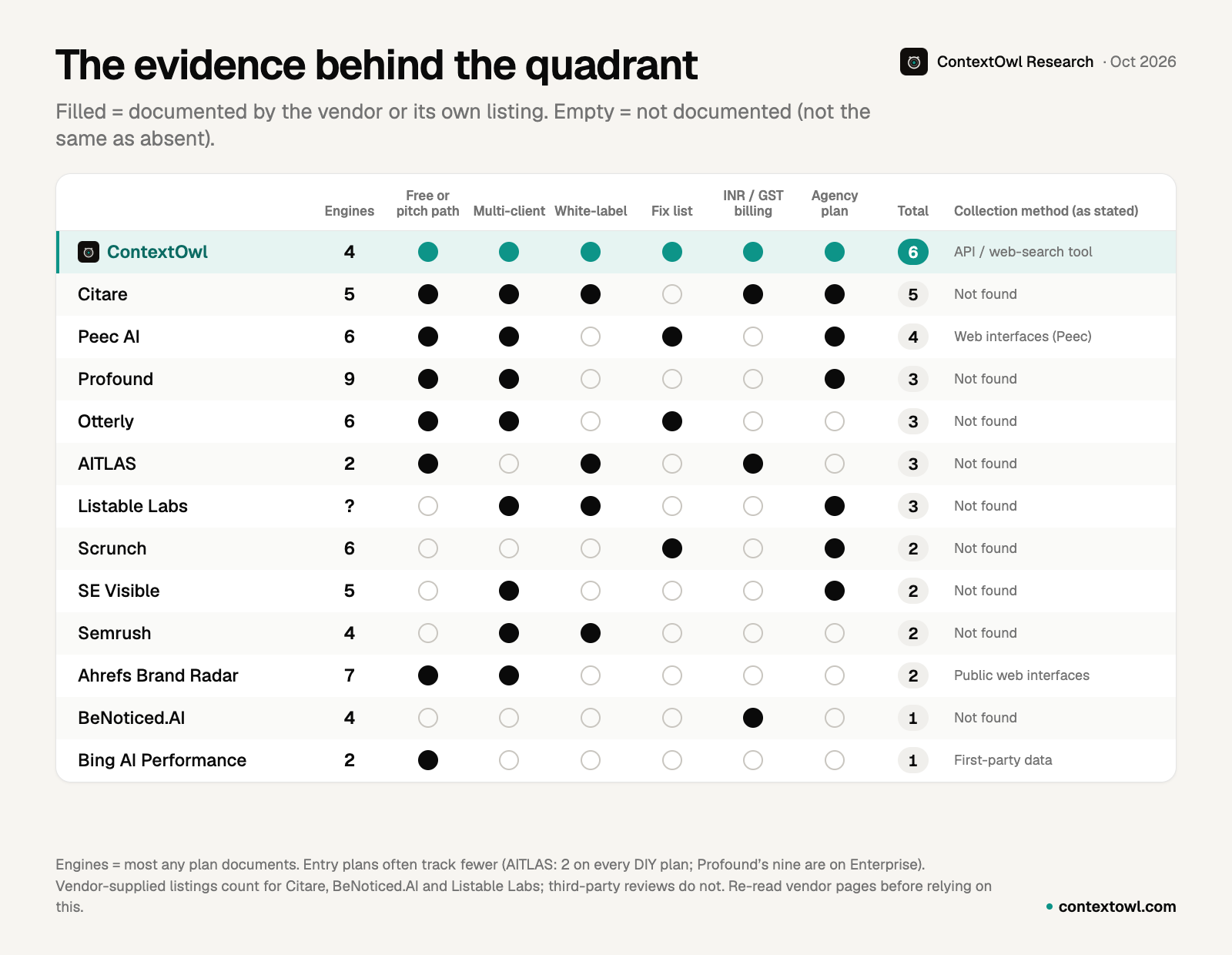
Figure 7. What each vendor documents publicly. A filled circle means documented by the vendor or its own listing. An empty circle means not documented, which is not the same as absent.
Three biases you should know about before you trust any of this. We chose the six features, and ContextOwl comes out top on them. Rupee and GST billing naturally favours India-built tools. And several vendors publish very little, so their counts are floors, not verdicts. If a dot looks unfair to a vendor, the fix is simple: they publish the fact, and the dot moves.
Daily-tracking platforms
Profound
- Pain points it speaks to: pitching (5), depth for large accounts (1, 2).
- Starts at: a free trial (10 prompts, run once, ChatGPT only). Enterprise is custom. Agencies: $99 a month plus $399 per client workspace, with 10 pitch workspaces a month.
- Stronger at: up to nine engines, daily prompts, SSO/SAML and SOC 2.
- Watch-out: older articles still quote $99 and $399 self-serve brand plans, which Profound’s own page no longer offers as of our reading. The per-client workspace fee scales linearly (pain point 4).
Peec AI
- Speaks to: multi-client retainers (4), pitching (5).
- Starts at: about $95 (€89) a month for brands. Agency plans: Essential $245 (3 projects), Growth $495 (10), Scale $795 (25).
- Stronger at: free 7-day pitch projects so prospects do not cost you quota, unlimited users, daily tracking, and “Actions” that turn source data into opportunities.
- Watch-out: project caps by plan, and EUR-native pricing.
Otterly
- Speaks to: low-cost starts (4), multi-client (4).
- Starts at: $29 a month (Lite, 15 prompts). Standard $189 (100 prompts), Premium $489 (400).
- Stronger at: the lowest entry price, four engines included (ChatGPT, Google AI Overviews, Perplexity, Copilot), and unlimited workspaces on Standard and Premium.
- Watch-out: Gemini and Google AI Mode are paid add-ons, Lite is one workspace, and payment is by credit card.
Scrunch
- Speaks to: enterprise-grade accounts (1, 2).
- Starts at: $300 a month (350 custom prompts, 3 licences). Growth $500, Pro $1,000.
- Stronger at: six engines on every plan, including Claude and Meta AI, plus personas, page audits and AI bot traffic monitoring.
- Watch-out: the highest entry price here, and its agency program sits on a separate page we did not review.
SE Visible (by SE Ranking)
- Speaks to: SEO-first agencies (4, 6).
- Starts at: $189 a month on its own site (about 12,000 AI answers analysed a month). A reseller listing in India shows a $99 entry plan and GST invoices.
- Stronger at: five engines, 7 countries and 5 languages, and white-label through SE Ranking’s agency pack ($69 add-on, per a third-party listing).
- Watch-out: prices differ by source. Confirm the plan and add-on cost.
Inside an SEO suite you may already pay for
Semrush AI Visibility Toolkit
- Speaks to: teams already on Semrush (4, 6).
- Starts at: $99 a month per domain (1 domain, 25 prompts). Extra domain $99. Extra 50 prompts $60. White-label via a $20 a month Pro Report.
- Stronger at: it sits beside the SEO data you already use. Engines: ChatGPT, Google AI, Gemini, Perplexity.
- Watch-out: prompt tracking is US-only per Semrush’s help page (pain point 8), and cost scales linearly per domain.
Ahrefs Brand Radar
- Speaks to: research across many brands (1, 5).
- Starts at: $199 a month per AI index, or $699 for all indexes with 2,500 custom-prompt checks. Custom-prompt packs from $50 a month, per Ahrefs.
- Stronger at: a huge pre-collected prompt database you can search with no setup. Useful for pitch research.
- Watch-out: it is a research index first. By Ahrefs’ own methodology, chatbot data refreshes monthly (AI Overviews and AI Mode update continuously), and custom prompts can run as often as daily. Check how they work for your clients’ markets.
If your client reports already live in AgencyAnalytics, its AI Tracker launched on 17 July 2026. We did not review its pricing.
Built in India or billed in rupees
AITLAS by Shiprocket
- Speaks to: India fit (8), Indian ecommerce and D2C clients.
- Starts at: free (₹0, 3 scans, 2 platforms, 15 prompts). DIY ₹999, ₹4,999 and ₹12,999 a month, plus 18% GST. Managed ₹24,999, ₹54,999 and ₹89,999 a month. See its pricing page.
- Stronger at: rupee billing, a free plan, and a managed service. White-label reports are included on its two higher managed plans.
- Watch-out: every DIY plan tracks 2 AI platforms. Managed plans need a 3-month minimum. It also sells managed work directly, so for an agency it can be a partner or a rival.
Citare
- Speaks to: rupee billing and agencies (4, 8).
- Starts at: free forever. Pro ₹9,999 a month, Agency ₹24,999 (or $119 and $299), with rupee billing and GST invoices.
- Stronger at: five engines at every paid tier, and an Agency tier that removes Citare branding from client deliverables.
- Watch-out: we saw these prices on directory listings (SaaSWorthy, SaaSHub), not on Citare’s own page. Confirm there.
Listable Labs
- Speaks to: agencies wanting client workspaces (4, 6).
- Starts at: varies. Its own blog quotes $249 a month for 5 client workspaces, 200 prompts and white-label reports, and another of its posts quotes a different start.
- Stronger at: built in Bengaluru, with agency workspaces in view.
- Watch-out: published prices were not consistent across its own pages. Ask for a written quote.
BeNoticed.AI
- Speaks to: India-region prompt tracking (8).
- Starts at: about $91 to $571 a month, per an AlternativeTo listing.
- Stronger at: described as India-first, with India-region and Indian-English prompt tracking and rupee plus GST billing, across ChatGPT, Claude, Gemini and Perplexity.
- Watch-out: we found this on a directory page, not the vendor’s. Verify.
Watch list, not verified: Citedar (English and Hindi, with a free audit) and GetCito (open source and self-hostable). AthenaHQ, Writesonic, Rankscale, LLMrefs and Trakkr appear on other roundups; we did not review them.
A one-time report
- Speaks to: proof (1), pitching (5), scope (7), margin (4), India fit (8).
- Starts at: a free AI Visibility Score in about 90 seconds, no signup. The full report is ₹1,799, once. A competitor is +₹249, an engine (Gemini, Perplexity or Claude) is +₹449, and 10 more prompts are +₹749 per selected engine. Prices are in rupees, charged through Razorpay.
- Stronger at: no subscription, no seats, and a cost that sits with the work you sell. Your logo, name and tagline go on the report, and each report has its own client site, competitors and prompts. You get the real answers, every cited source, and a ranked fix list as a PDF and a 12-sheet XLSX tracker you can turn into a statement of work.
- Where it is weaker: it does not run daily or send alerts, so there is no trend line unless you run it again. It does not cover Google AI Overviews or Copilot. It has no SSO or SOC 2. Reports are in English. It queries engines via API or web-search tools, once per prompt, so treat a report as a snapshot.
- See it: the free score, the sample report, the agency page, and the honest comparisons with Profound, Otterly, Peec AI and Semrush AI.
Free
Bing Webmaster Tools, AI Performance. Microsoft’s own dashboard shows how a site is cited in Copilot and Bing’s AI answers, with grounding queries. It covers Microsoft’s surfaces only, but for a client already on Bing Webmaster Tools it is a no-cost first look.
A manual check. Write five to ten buyer questions without the client’s name. Ask each on two engines in fresh chats, log what you see, repeat on another day. Free, and fine for a first look. It gets hard to defend once a client wants the same questions run the same way across engines and competitors.
Part 5: The money, worked out
Five clients, one quarter. List prices, ten prompts per client, billed monthly, before tax. This is not like-for-like: monitoring tools run daily, while a one-time report is a snapshot. Each figure stays in the vendor’s own currency.
Here is the quarter drawn out. Each dark block is one month of a subscription.
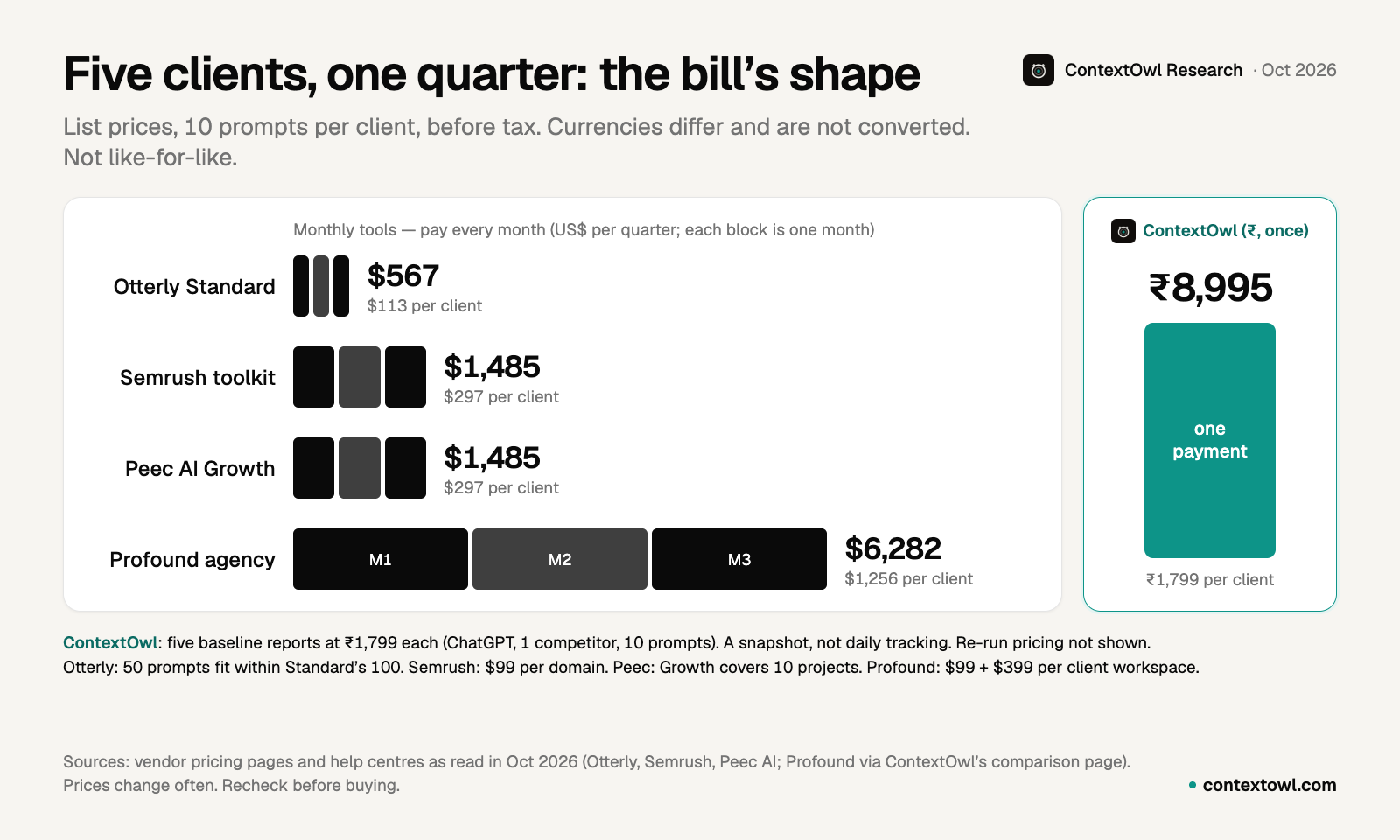
Figure 8. Five clients, one quarter, at list prices with 10 prompts per client, before tax. Currencies differ and are not converted. Not like-for-like. Sources: vendor pricing pages and help centres, October 2026.
Read it left to right as a story about shapes. Otterly Standard comes to $567 over the quarter, with 50 prompts fitting inside its 100. Semrush at $99 per domain, and Peec AI’s Growth plan, each come to $1,485. Profound’s agency pricing, $99 plus $399 for each of five client workspaces, comes to $6,282. And five ContextOwl baseline reports at ₹1,799 each, with ChatGPT, one competitor and 10 prompts apiece, come to ₹8,995, paid once.
The point is not that one is cheap, and the bars are not a league table. The shape of the bill is different. Per-workspace and per-domain tools scale with your client count. Per-prompt tools scale with how much you watch. A one-time report charges you when you run it.
The margin lens. Published Indian GEO and AEO retainers run roughly ₹40,000 to ₹1.5 lakh a month for most small and mid-sized businesses, and published Indian AI visibility audits start around ₹24,999, according to one Indian agency’s pricing guide. Against numbers like those, the tool is the cheap part. Your real cost is the hours spent interpreting results and talking a client through them. That is why output you can brand and hand over (pain point 6) and a fix list you can scope (pain point 7) matter more than a cheaper dashboard.
Part 6: When to use what
By situation
You need to pitch a prospect this week. Start with a free score (ContextOwl’s takes about 90 seconds, no signup) or a free plan (AITLAS, Citare). If you will pitch often, Peec AI’s free 7-day pitch projects and Profound’s 10 monthly pitch workspaces are built for it. (Pain point 5)
You want a one-off audit plus a fix list to scope. A one-time report fits. Hand the client the evidence, the sources and a ranked fixes tracker. (Pain points 1, 7)
You run ongoing retainers for several clients. Choose a daily-tracking platform and price it at your real client count: Peec AI agency plans, Otterly Standard or Premium, SE Visible with its agency pack, or Citare’s Agency tier. (Pain point 4)
You already live in Semrush or SE Ranking. Add the AI module and use its white-label reports. Check the US-only prompt note first. (Pain points 4, 6, 8)
You research many brands for pitches or competitive work. Ahrefs Brand Radar’s pre-collected index is built for it. (Pain point 5)
Your clients are Indian ecommerce or D2C brands. AITLAS is the India-specific option, billed in rupees. Weigh its 2-platform DIY limit. (Pain point 8)
You need rupee billing and GST invoices. AITLAS, Citare and BeNoticed.AI say they offer them, and SE Visible’s Indian reseller listing mentions GST invoices. Confirm each. (Pain point 8)
Your client is a global enterprise with compliance rules. Profound Enterprise or Scrunch Enterprise. (Pain points 1, 2)
You have no budget yet. Do the manual check, open Bing’s AI Performance, and run the free score. (All of them, a little)
Three stacks that work
The lean India agency stack. A free score for pitching, a one-time report per client for the baseline and fix list, and one low-cost tracker (Otterly Lite or Citare’s free tier) on your two or three flagship accounts. Spend on tracking only where a retainer justifies it.
The SEO-suite stack. Stay in Semrush or SE Ranking for tracking and white-label reporting, and add a one-time report when a client needs an evidence pack and scoped fixes.
The enterprise stack. Profound or Scrunch for daily depth and compliance, with a one-time report for the executive pitch.
The pattern: use a one-time report for the baseline and the scope, and a tracker only for the trend. That is a decision about jobs, not brands.
Part 7: Your first 30 days
Week 1: baseline three clients. Pick your three most AI-curious clients. Run a free score on each. Write five to ten buyer questions per client without their brand name. Log named, cited, recommended and accurate.
Week 2: build your proof. Run a full baseline report for each. Note where a competitor is named and the client is not, and which sources are cited for rivals. Turn the ranked fixes into a one-page scope.
Week 3: pilot one tracker. Choose one daily tool, model its price at your real client count, and ask the five vendor questions above. Check a sample answer against a real one.
Week 4: package it. Offer a baseline audit, a fix retainer and a re-check. Promise the work and the re-check, never the result. Say plainly that AI answers vary and that you report a rate across runs.
The honest bit
No tool decides whether a client shows up in an AI answer. Each engine makes its own call, and answers change from run to run. What a good tool does is show you the real answers, the sources behind them, and what to fix. What you do with that is the part clients pay for.
So back to that Monday. Run a free score before the call. Open the answers. Bring a fix list, not a feeling.
You will be the one with the answer.
Try it free: Get your free AI Visibility Score · See a sample report · For agencies
Sources
Agency and market research
- AgencyAnalytics, 2026 Marketing Agency Benchmarks Report (494 respondents, Feb to Apr 2026; methodology on page): https://agencyanalytics.com/agency-benchmarks-2026
- AgencyAnalytics, attribution findings: https://agencyanalytics.com/blog/agency-benchmarks-2026-attribution
- AgencyAnalytics, AI Tracker launch (17 Jul 2026): https://agencyanalytics.com/company/newsroom/press-release-ahead-of-next
- Conductor, 2026 AEO/GEO CMO Investment Report, press release (13 Jan 2026): https://www.businesswire.com/news/home/20260113439299/en/New-Conductor-Survey-of-Enterprise-CMOs-Shows-AEOGEO-Investment-Is-Accelerating-and-Late-Movers-Are-at-Risk
- SparkToro, zero-click study with Similarweb data (Jun 2026): https://sparktoro.com/blog/in-2026-less-than-one-third-of-google-searches-still-send-a-click/
- Pew Research Center, AI summaries and clicks (22 Jul 2025): https://www.pewresearch.org/short-reads/2025/07/22/google-users-are-less-likely-to-click-on-links-when-an-ai-summary-appears-in-the-results/
- Seer Interactive, “AI visibility is a vanity metric” (Jan 2026): https://www.seerinteractive.com/insights/ai-visibility-is-a-vanity-metric-prepare-your-execs
- No Hacks podcast, ep. 219 with Rand Fishkin: https://nohacks.co/episode/219-your-homepage-is-not-your-homepage-anymore-with-rand-fishkin
India
- TechCrunch, ChatGPT 100M weekly users in India (Feb 2026): https://www.techcrunch.com/2026/02/15/india-has-100m-weekly-active-chatgpt-users-sam-altman-says/
- YourStory, Google AI Mode in India: https://yourstory.com/ai-story/google-ai-mode-search-live-india
- TechCrunch, AI Mode adds seven Indian languages (8 Oct 2025): https://techcrunch.com/2025/10/08/googles-search-live-comes-to-india-ai-mode-gets-more-languages
- Indian AEO and GEO pricing guide (agency blog): https://www.thebilliongame.com/blog/aeo-pricing-india
How the tools measure
- SparkToro and Gumshoe.ai, consistency study, via Search Engine Journal: https://www.searchenginejournal.com/ai-recommendations-change-with-nearly-every-query-sparktoro/566242
- SparkToro, Office Hours: Can you actually track AI visibility?: https://sparktoro.com/blog/office-hours-can-you-actually-track-ai-visibility/
- Promptwatch (vendor), ChatGPT UI vs API: https://promptwatch.com/blog/ui-vs-api-for-ai-search-visibility
- Paprik.ai (vendor), API vs ChatGPT UI: https://paprik.ai/blog/accurate-api-based-ai-visibility-tracking-chatgpt-ui
- Trakkr, Peec AI data accuracy and collection method (summarising Peec’s docs): https://trakkr.ai/reviews/peec-review/data-accuracy
- ContextOwl FAQ (method, pricing, tools): https://contextowl.com/faq
Tool pages
- Profound pricing, as read by ContextOwl (3 Oct 2026): https://contextowl.com/alternatives/profound
- Otterly, plans and pricing: https://help.otterly.ai/pricing-of-otterlyai
- Peec AI, agency pricing: https://peec.ai/pricing-agencies · pricing update: https://peec.ai/blog/pricing-update
- Scrunch pricing: https://scrunchai.com/pricing
- SE Visible, for agencies: https://visible.seranking.com/for-agency-owners/ · Techjockey listing: https://www.techjockey.com/detail/se-visible
- Semrush AI Visibility Toolkit: https://www.semrush.com/kb/1493-ai-visibility-toolkit · pricing: https://semrush.com/pricing/ai
- Ahrefs Brand Radar: https://help.ahrefs.com/id/articles/11064852-tentang-brand-radar · https://www.ahrefs.com/use-cases/aeo
- AITLAS by Shiprocket: https://aitlas.shiprocket.in/pricing/
- Citare via SaaSWorthy: https://www.saasworthy.com/product/citare/pricing · SaaSHub: https://www.saashub.com/citare
- Listable Labs (own blog): https://www.listablelabs.com/blog/7-best-ai-visibility-tools-for-marketing-agencies-2026-comparison
- BeNoticed.AI (AlternativeTo): https://alternativeto.net/software/benoticed-ai/about/
- Bing AI Performance (Microsoft Advertising, Mar 2026): https://about.ads.microsoft.com/en/blog/post/march-2026/the-ai-performance-dashboard-your-view-into-where-your-brand-appears-across-the-ai-web
- Benchmark of 42 vendors (Trakkr, a competitor to several of the tools): https://trakkr.ai/ai-visibility-pricing-benchmark
- ContextOwl for agencies: https://contextowl.com/for-agencies