- A trustworthy report discloses exactly what it ran: which prompts, which engines, how many runs per prompt, and on what date — without that, a score can't be checked by anyone.
- A single headline score is a summary of several underlying numbers (visibility, share of voice, sentiment, position). Treat it as a starting point for a conversation, not the conversation's conclusion.
- Separate evidence sections (real quoted answers, with their sources) from summary sections (the score, the chart). Evidence can be checked against the live engine; summary can't.
- Red flags: no visible prompt list, no run count, no date, a "ranking" presented as if it were stable, or a score with no stated method.
- Every report, including ContextOwl's own, is a point-in-time snapshot — a strong read on one day, not a monitoring feed, and not a guarantee of what the engine will say tomorrow.
What should a report disclose?
At minimum: the exact prompts run, which engines, how many times each prompt ran, the date it ran, and how brand mentions were counted (named only, cited, recommended, or some blend). If any of these is missing, the report is asking you to trust a number you can't independently check — you can't go run the same prompt yourself and compare, because you don't know what was actually asked.
This is the same discipline the Authority Content System behind ContextOwl's own editorial work holds itself to: "every data post states the prompts, the engines, the dates and the number of runs." A report that doesn't meet that bar for its own methodology is asking for more trust than it's earning.
How is a score built?
Most AI visibility scores roll up from four underlying metrics, not one measurement:
- Visibility — how often the brand is named across the prompts run.
- Share of voice — the brand's slice of all brand mentions across those prompts, relative to named competitors.
- Sentiment — whether the brand is described positively, neutrally or negatively when it is named.
- Position — where the brand lands in the answer when it's named, with some reports tracking this and some not.
ContextOwl's own sample report, for a fictional task-management brand called "YOURS" against a fictional competitor, "Brightboard" (every name in it is invented — the page says so directly), shows this layered structure in practice: an overall score and grade visible for free, then a full competitive breakdown, a citations-and-sources chapter, a sentiment chapter, and a per-prompt evidence chapter behind it. The free score answers "roughly where do I stand"; the paid chapters answer "why, and against what evidence."
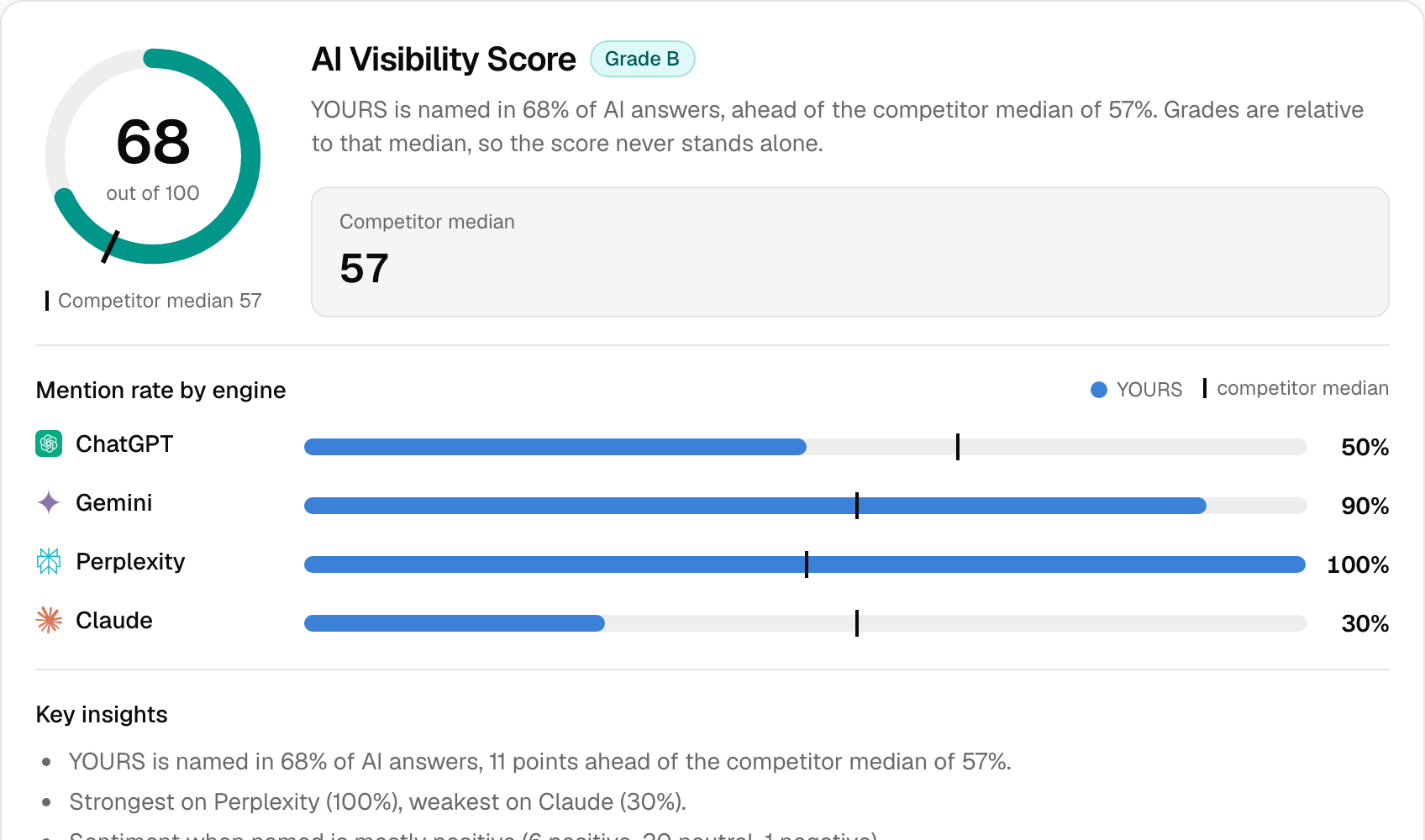
Whatever the exact formula, a defensible score comes with a stated method — which metrics feed it, how they're weighted, what counts as a "mention." A score with no stated method is just a number someone decided to show you.
Which sections give evidence vs summary?
This is the single most useful filter for reading any report fast. Split every section into one of two buckets:
| Section type | What it is | How to use it |
|---|---|---|
| Summary | Scores, grades, charts, rankings | A starting read — note it, don't stop there |
| Evidence | Quoted AI answers, named sources/citations, per-prompt breakdowns | Checkable — you can re-run the same prompt and compare |
A competitive-analysis chapter that shows "named ahead of competitor X in 6 of 10 prompts" is summary. A per-prompt chapter that quotes the actual answer text, with the brand and competitor names marked in context and the cited sources listed underneath, is evidence. Both have a place, but only the second kind lets you (or anyone reviewing the report) check the claim against reality.
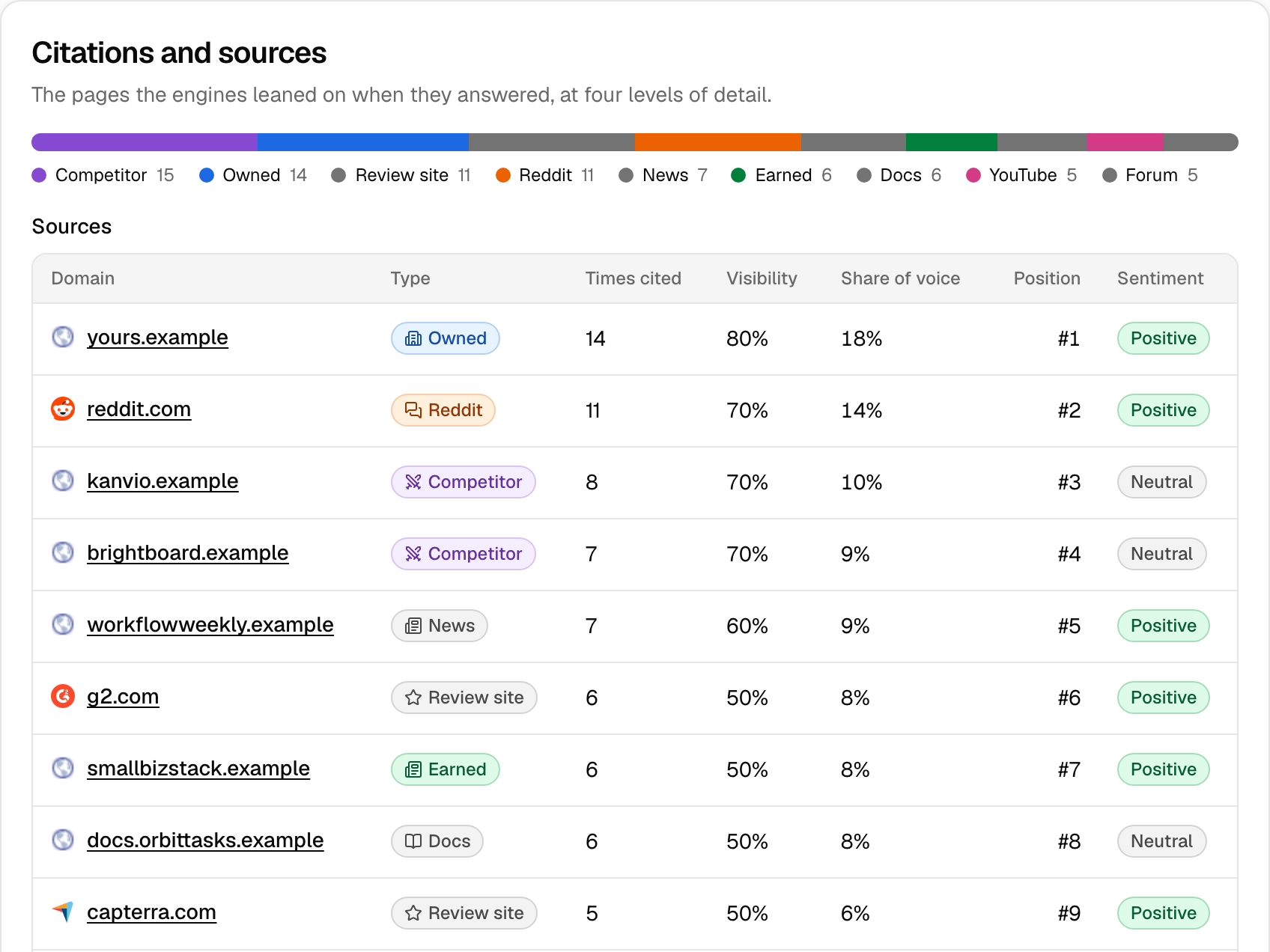
A report built entirely from summary sections, with no quoted answers or named sources anywhere, is asking you to trust its own interpretation of the underlying data with no way to spot-check it.
What are red flags?
- No prompt list anywhere in the report. If you can't see what was actually asked, you can't judge whether the questions matched real buyer language or were picked to produce a flattering result.
- No run count, or language implying one clean answer settled the question. Answers vary run to run — the same prompt on the same engine rarely returns the same brand list twice. A report built on a single run per prompt is directional at best; one that doesn't say how many runs it used is hiding that limitation rather than disclosing it.
- No date, or a date buried deep in an appendix. Engine behavior, pricing data and even which sources get cited change over months, not years. A report with no visible date is either new (fine, if dated) or quietly stale.
- A "rank" presented as stable. AI answers aren't a search results page with ten fixed slots; the same brand can appear first in one run and not at all in the next. A report that talks about "rank #2 in ChatGPT" the way you'd talk about a Google ranking is importing a concept that doesn't transfer cleanly.
- A score with no stated method, or a method that changes between reports without saying so.
- Sentiment reported with no quoted context. "68% positive sentiment" with no example of what a positive mention actually said is a number you can't sanity-check.
How should a team act on a report?
Start with the evidence sections, not the score. Read a handful of the actual quoted answers and ask: does this match what I'd expect a real buyer to see? Then use the summary sections (score, competitive position, sentiment trend) to prioritize where to look first — a category where you're named least often, or where sentiment skews negative, is a better place to start than wherever the chart happens to draw attention.
Treat the whole thing as a snapshot, not a verdict. A report run today describes today's answers on the prompts it ran; it doesn't predict next month's, and it isn't a substitute for checking again later if something material changes (a product launch, a new competitor, a pricing change). That's true of every report in this category, ContextOwl's own included — a point-in-time read, not a standing promise about what the engine will keep saying.
A quick disclosure checklist
- Exact prompts listed, not just categories or counts.
- Engines named specifically (not just "AI engines").
- Run count per prompt stated.
- Report date visible, not buried.
- At least one evidence section with quoted answers and named sources.
- Scoring method explained in plain language.
- If competitors are named, the report says how they were chosen.
FAQ
Is a higher score always better? Not on its own. A score that's high because of one strong prompt and weak everywhere else tells a different story than a consistently solid one — check the per-prompt breakdown before treating the headline number as the whole picture.
Why does ContextOwl's sample report use fake brand names? So the example is honest about being an example. "YOURS" and its fictional competitors let the report show every chapter and every kind of finding without describing a real company's real AI presence.
Can a report's score change if I ask the same question again myself? Yes, and that's expected, not a sign something's broken — see why one visibility number can mislead for why a single score is a summary of variable underlying answers, not a fixed measurement.
What's a reasonable gap between reports from the same provider? Any report should disclose that it's a snapshot, not a tracker. If you need to check whether anything material changed, re-running after a real event (a launch, a competitor move) makes more sense than running on a fixed schedule for its own sake — see snapshot or monitoring for that trade-off directly.
What to do next
- Before trusting any report's score, find its prompt list, run count and date — if you can't find all three, treat the score as unverifiable.
- Read at least three quoted evidence sections before looking at the summary charts, so your first impression comes from actual answers, not a chart.
- If you're choosing between visibility tools, use 15 questions to ask before picking one — disclosure is one of them, not the only one.
ContextOwl sells one-time AI visibility reports. The sample report is free to read in full — every chapter, with the same fictional brand throughout — so you can see exactly what's being described above before paying for anything.
Sources
- ContextOwl sample report (
/sample-report), fictional brand "YOURS" vs fictional competitor "Brightboard" — internal product page, no external sourcing required (the page states its own fictional status). - ContextOwl product positioning and report architecture (report chapters, free score, paywall structure): internal reference.
More in Measurement
Bing was the first major engine to give publishers free citation data — total citations, cited pages, and the grounding queries behind them. Here's what it shows and what it doesn't.
Citation share is the slice of an answer's sources that are actually yours — not how often you're mentioned, and not the same thing as share of voice.
Perfect AI attribution doesn't exist. Teams that are measuring anything real rely on proxies: self-reported source, branded search lift, direct traffic, and sales-call mentions.