- There's no single, published "citation algorithm" any engine runs. What's documented is a pipeline: retrieve candidate pages, ground the answer in them, cite what got used. The exact ranking inside that pipeline isn't public.
- Research links citation to several signals — but almost all of it is correlational, not a confirmed cause. Treat every number here as "associated with," not "guaranteed to produce."
- About 80% of AI-cited URLs don't rank anywhere in Google's top 100 results for the same query. AI retrieval and traditional search ranking are measurably different processes.
- Page type matters a lot, and it's industry-specific: articles, listicles and product pages dominate overall, but the winning type flips by category (homepages for local services, program pages for higher education).
- A page getting retrieved and a page getting cited are two different events — one health publisher in a 25,000-citation study was retrieved constantly but cited at a much lower rate than a more specialized rival.
What steps lie between a question and a cited page?
Three stages, documented at a high level by the engines that explain their own process, though none publish the exact ranking formula inside each step:
- Retrieval. The engine pulls a set of candidate pages that look relevant. Google describes this directly for its own AI features: a technique "also known as grounding" that relies on "our core Search ranking systems to retrieve relevant, up-to-date web pages." Engines like Gemini and Claude that support live web search decide, per prompt, whether a search is worth running at all before retrieval happens.
- Reading and reranking. The engine reviews the specific information in the retrieved pages, not just their ranking position, to decide what's useful for answering the question. A page that ranks low but answers the exact question directly can outperform a page that ranks higher but buries the answer.
- Grounding and citation. The final answer is composed from what got used, with citations attached to the specific claims that came from a specific source.
Retrieval decides who's in the room, reading-and-reranking decides who gets listened to, and citation decides who gets credited. A page can succeed at one stage and fail at another — retrieved but not cited is a real, measured pattern (see below), not a hypothetical.
Which signals does public research link to citation?
Four independent studies converge on similar themes, though each measures something slightly different and none of them proves causation:
| Signal | What the research found | Source |
|---|---|---|
| Page type matches the question | Listicles, articles and product pages dominate overall citations, but the winning type varies sharply by category and by intent | DeltaV (25,337 citations) and Wix Studio/Peec AI (1.05M citations across 75,000 answers) |
| Freshness | Grounding is explicitly framed by Google as improving "quality, accuracy and freshness" — current information is retrieved over stale information when the question is time-sensitive | Google Search Central |
| Authority and accuracy (not just visibility) | A page can be retrieved constantly and still get cited rarely if it's broad and unspecialized; a narrower, more authoritative source gets cited at a much higher rate per retrieval | DeltaV |
| User intent | Intent (informational, commercial, transactional, navigational) predicts citation type better than industry or which AI model answered | Wix Studio/Peec AI |
None of these are "add X and get cited." They're associations found in large data sets — correlational, not a controlled experiment. Both studies measure what already got cited and work backward to the pattern; neither tested whether changing a page's type or structure causes more citations.
Why are some pages ignored?
Three real patterns, from the sourced studies, cover most cases:
The page was never retrieved. If a page can't be crawled, isn't indexed, or doesn't surface for anything close to the actual question, it's never a candidate — nothing about reranking or citation matters yet. This is a technical-access problem, not a content-quality one.
The page was retrieved but outranked for relevance. The content exists and is crawlable, but something else answered the specific question more directly, more currently, or in a format the engine favored for that intent (a listicle for a commercial "best of" question, a product page for a transactional one).
The page was retrieved constantly and still barely cited. This is the pattern DeltaV's study surfaced most clearly: across three major health publishers, pages were retrieved frequently but cited at rates of 0.55, 0.33 and 0.24 citations per retrieval, while a more specialized competitor (Mayo Clinic) reached 1.79. The study calls this a "trust gap" — breadth and general visibility don't guarantee the engine treats a page as the authoritative answer once it's reading the content. Comparison pages showed the reverse problem: only 4.1% of total citations despite the highest citation rate once retrieved (1.87, about 45% above average) — a format that works well when used, but isn't produced or surfaced as often as it seems to deserve.
Which signals can a team influence?
Realistically, three of the four:
- Page type and format, matched to how buyers at that funnel stage actually ask. A listicle-style "best of" page for commercial-intent questions; a direct product page for transactional ones; a thorough article for informational ones. See which content types AI engines cite most for the fuller breakdown by industry and intent.
- Freshness, in the literal sense of keeping facts current and visibly dated — pricing, availability, anything with an "as of" quality to it.
- Specificity and extractable facts, the same discipline covered in which AI engines to prioritise: state the number, the constraint, the direct answer, rather than making a reader (or a model) infer it.
Authority, as DeltaV's study frames it, is harder to influence directly — it's closer to an earned reputation signal than a markup change. What a team can do is make sure the content that does exist is specific enough to be the clearly-better answer to the exact question, rather than a broad page that's merely relevant.
How to diagnose a page that is never cited?
A quick diagnostic, symptom to likely cause to what to check:
| Symptom | Likely cause | How to check |
|---|---|---|
| Page never shows up as a source for any relevant prompt | Not retrieved at all — a crawl or indexing problem, or a blocked crawler | Confirm AI crawlers can fetch the page; see the AI bot access checker and whether blocking the wrong bot is the cause |
| Page is retrieved (engine seems to "know" the content) but never linked | Outranked at the reading/reranking stage, or wrong format for the question's intent | Compare your page's format against what competitors use for the same question type (listicle vs article vs product page) |
| Page is cited occasionally but a narrower competitor is cited far more | A DeltaV-style "trust gap" — broad but not the clear best answer for the specific question | Check whether a more specialized page (narrower topic, more direct answer) exists or should exist on the same question |
| Facts on the page are accurate but outdated-looking (old prices, old screenshots, no visible update date) | Freshness signal working against the page | Update the page and its visible "last updated" date, not just the underlying fact |
| Page answers the question but the answer is buried past several paragraphs of context | Direct-answer placement, not a retrieval problem | Move the direct answer to the first 100 words; the Google guidance and multiple independent studies both support answer-first structure for AI retrieval |
A page that's never cited for you but regularly cited for a named rival on the same questions is a distinct diagnostic worth running on its own — see citation gap analysis for how to compare the two side by side.
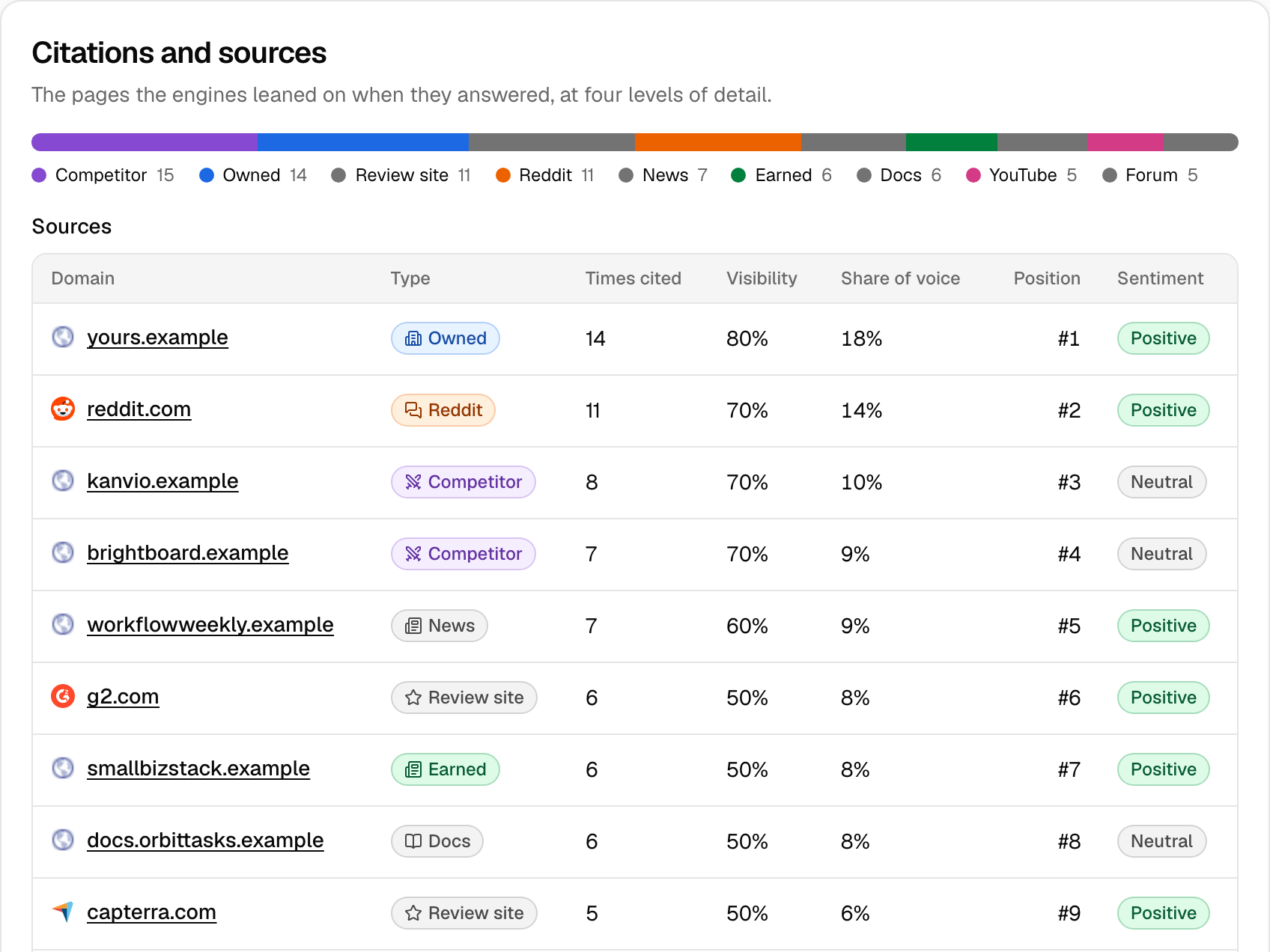
The image below shows what a citation breakdown looks like once you can see it directly — which domains got cited, how often, and at what position, split by source type.
FAQ
Is there a confirmed citation algorithm any AI engine follows? No engine publishes one. What's documented is a retrieve-read-cite pipeline, with the exact ranking inside it undisclosed. Treat any claimed "formula" from a third party as a correlational finding, not the real mechanism.
Does ranking well on Google guarantee an AI citation? No. About 80% of AI-cited URLs don't rank in Google's top 100 results at all for the same query, per Ahrefs' 15,000-query study — retrieval for AI answers and traditional search ranking are measurably different processes.
Does adding more structured data (schema) help get a page cited? Google states directly that structured data "isn't required for generative AI search, and there's no special schema.org markup you need to add" for its own features. That's specific to Google; it doesn't rule out a benefit for other engines, but no sourced study in this post found one.
Why would a page get retrieved constantly but cited rarely? DeltaV's 25,337-citation study found exactly this pattern for broad, high-traffic health publishers versus a narrower, more specialized competitor — described as a "trust gap." Being found isn't the same as being treated as the best answer.
What's the single most useful page-level change for citation? No study in this post isolates one single lever with a proven causal effect. The most consistent pattern across them is matching page format to question intent (listicle for commercial, product page for transactional, article for informational) combined with a clearly stated, current, specific answer.
What to do next
- Confirm your most important pages are actually retrievable — check crawler access before assuming it's a content problem.
- Pick your three highest-intent pages and check whether their format matches how buyers actually ask (listicle, article or product page) for that intent.
- Audit for staleness: any page with a price, a feature list or an availability claim older than a quarter should show a visible, current update date.
ContextOwl sells one-time AI visibility reports. The AI Citation Snapshot is a free, single-question version of the same check.
Sources
- Google Search Central, "Optimizing your website for generative AI features on Google Search" (updated 10 July 2026): https://developers.google.com/search/docs/fundamentals/ai-optimization-guide
- Ahrefs, Louise Linehan, "AI Search Overlap" study (11 August 2025; 15,000 long-tail queries via Ahrefs Brand Radar): https://ahrefs.com/blog/ai-search-overlap/
- DeltaV Digital, "AI Search Citations Study" (13 July 2026, updated 28 September 2026; 25,337 citations across 21,075 AI engine responses, April-July 2026, ChatGPT/Perplexity/Gemini/Google AI Overviews/AI Mode): https://www.deltavdigital.com/resources/reports/ai-citation-study/
- Wix Studio AI Search Lab with Peec AI, "Content Types Most Cited by LLMs" (23 March 2026; 75,000 AI answers, 1,056,727 citations, ChatGPT/Google AI Mode/Perplexity): https://www.wix.com/studio/ai-search-lab/research/content-types-most-cited-by-llms
- ContextOwl sample report, citations-and-sources screenshot (illustrative example data).
More in AI Search Basics
A results page ranks pages and lets you choose. An AI answer retrieves, selects and writes a few sentences that name a few brands for you.
AI knows a brand from memory built during training, or from pages fetched live. You can influence the second one quickly and the first one only slowly.
Each engine documents a little about how it finds sources and leaves most of the rest unpublished. Here's exactly what's confirmed, by whom, and what still isn't.