- There's no one engine to optimize for. Clear, well-structured, fact-stated content travels across most of them from a single source — the differences show up in retrieval and phrasing, not in needing five separate content strategies.
- Research disagrees on how much engines overlap. One large study found brands mentioned by ChatGPT, Google AI Mode and Google AI Overviews correlate strongly with each other (pairwise correlations of 0.75-0.82, averaging 0.779) — strong agreement on *which brands* show up, regardless of engine. A separate study found AI citations overlap with Google's own top 10 only about 12% of the time on average, with Perplexity a clear outlier at 28.6%.
- Pick your first one or two engines by where your buyers actually type questions, not by which is biggest overall.
- ContextOwl's reports currently cover ChatGPT as the base engine, with Gemini, Perplexity and Claude as add-ons — not Google AI Overviews, AI Mode or Copilot.
- Check engines individually and periodically. Being visible on one doesn't predict visibility on another.
How should a team choose which engines matter?
Deciding which platforms deserve attention is a real, named problem, not a minor detail — in a July 2026 Fractl survey of 343 US marketing decision-makers, 15% named "identifying platform priorities" one of their top operational challenges, behind only keeping pace with the landscape (28%) and measuring performance (17%).
Start with where your buyers actually are, not with a ranked list of "biggest AI engines." A few practical filters, roughly in order:
- Audience habits. A developer audience skews toward ChatGPT and Perplexity for research-heavy questions. A consumer-facing brand sees more traffic shaped by Google's AI Overviews and AI Mode, simply because they sit inside the search box most people already use. A B2B SaaS audience often mixes ChatGPT with Gemini (as the default for many Google Workspace users).
- Where the category gets discussed. If your category lives in long technical comparisons, Perplexity's citation-heavy style tends to matter more. If it's a fast consumer decision ("best X under $50"), the engines embedded directly in search matter more because that's where the question gets typed first.
- What's measurable today. ChatGPT, Gemini, Perplexity and Claude can all be queried directly, logged out, with a real prompt — a team can check these today. Google's AI Overviews and AI Mode sit inside Search itself and are harder to isolate and repeat cleanly; Copilot has even less published, checkable detail. Start where you can actually verify an answer.
A sensible default for a small team: pick one or two engines to check every time (commonly ChatGPT plus whichever matches your audience), and treat the rest as a periodic spot-check rather than a daily watch.
What travels across engines?
A single well-built source does most of the work across engines, because the underlying ask is the same: state the fact plainly, close to the surface, where it can be retrieved and quoted.
- A direct answer near the top of the page, not buried three paragraphs into context-setting.
- Specific, extractable facts — pricing with a number attached, not "contact us for pricing"; team-size limits; what's actually included in a free tier.
- Accurate basics that don't need the reader to infer anything — what the product does, who it's for, what it costs, stated in sentences an engine can lift.
- Freshness. All these engines prefer retrieving something current over something stale when the question has a time-sensitive edge (pricing, availability, "as of" claims).
None of this requires five different versions of a page, one per engine. It's the same discipline that Google itself describes for its own AI features — "rooted in our core Search ranking and quality systems," no special markup required, no page-chunking requirement — and the same shape of advice shows up independently in third-party citation research across engines (see how AI decides which pages to cite).
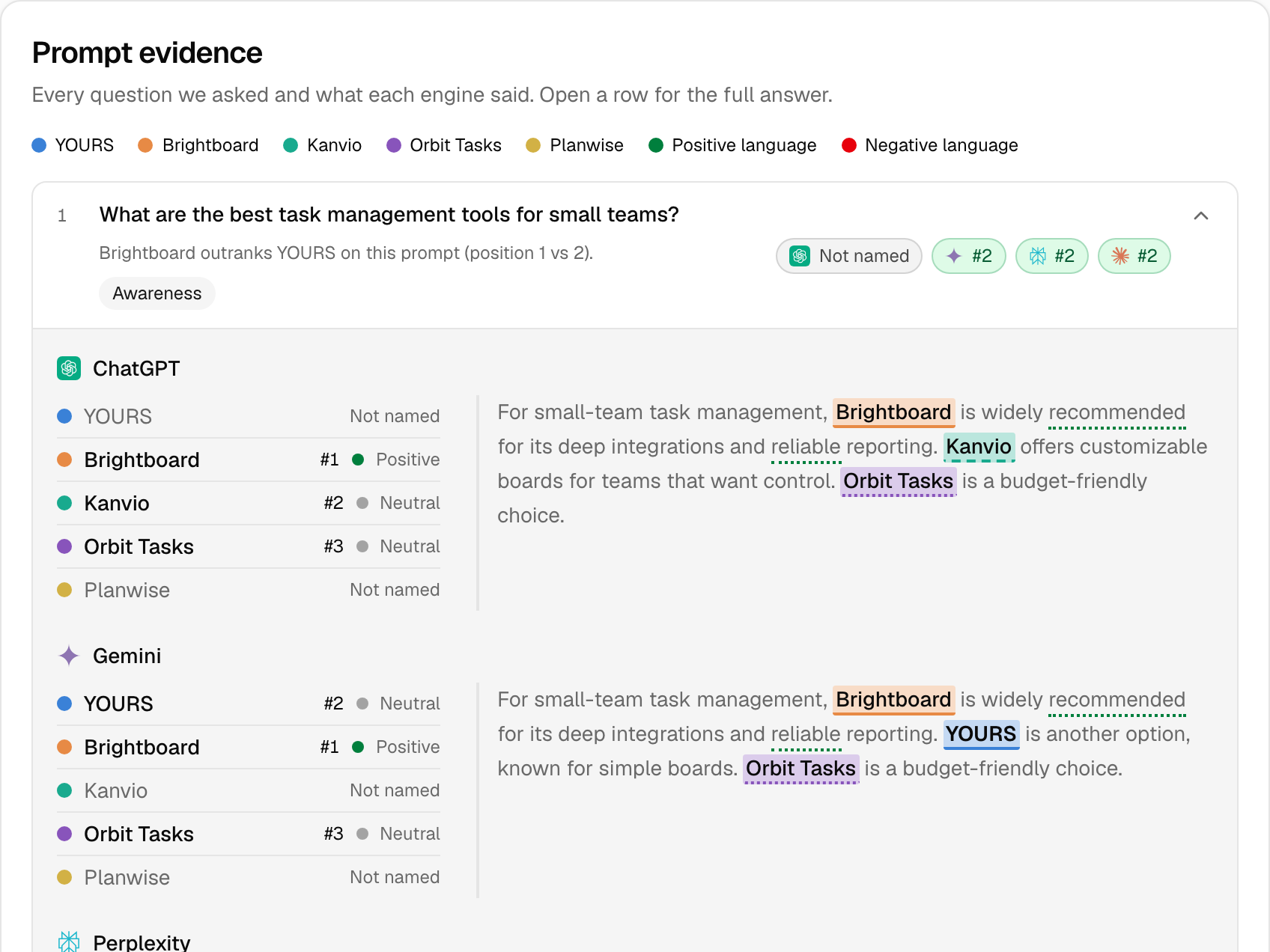
Here's what that looks like in practice: the same underlying source material, asked about through one engine at a time, producing different wording and a different ranked order per engine, even when the facts are consistent.
Where do engines differ?
They differ in retrieval source, citation style, and how much weight they put on different signal types:
| Engine | What's documented | What tends to differ |
|---|---|---|
| ChatGPT | Runs live web search on demand, on top of Microsoft's Bing index, separate from its training data | Named/cited/recommended can split apart in one answer — see how ChatGPT chooses sources |
| Google AI Overviews / AI Mode | Built on Google's core ranking systems, uses query fan-out (several searches per question) | AI Mode handles multi-step, conversational questions; AI Overviews handles single-shot summaries — see how AI Overviews and AI Mode pick what to cite |
| Perplexity | Citation-forward by design, built around linking sources inline | Highest overlap with Google's own top 10 among the engines Ahrefs measured (28.6% vs a 12% average for the others) — see how Perplexity chooses its sources |
| Gemini / Claude | Both support "grounding" with live web search that the model triggers per prompt, with inline citations | ContextOwl covers both as add-on engines, not the base check — see how Gemini chooses sources, how Claude chooses sources, and how Claude, Gemini and Copilot answer brand questions |
A common mistake is treating "visible in ChatGPT" as "visible in AI search" generally. A brand named and cited in ChatGPT can be completely absent from a Perplexity answer to the same question, because Perplexity is pulling from a differently-weighted citation pool.
How much do the engines overlap on brands?
The honest answer: it depends which kind of overlap you're asking about, and the two major studies measure different things.
Which brands get named, across AI-native answer engines. Ahrefs analyzed 75,000 brands (Domain Rating over 40, minimum 800 monthly search volume on their top keyword) and found strong agreement on which brands get mentioned across ChatGPT, Google AI Mode and Google AI Overviews: a 0.821 correlation between AI Mode and AI Overviews specifically, 0.769 between AI Mode and ChatGPT, and 0.749 between AI Overviews and ChatGPT — averaging 0.779 across all three pairs. The same study found YouTube mentions correlated most strongly with cross-platform visibility (about 0.737), ahead of backlinks or Domain Rating, which barely correlated at all (0.266-0.326).
Whether AI citations match Google's own top 10. A separate Ahrefs study of 15,000 long-tail queries found that, on average across ChatGPT, Gemini and Copilot, about 12% of AI citations also rank in Google's top 10 for the same query — Perplexity is the clear outlier at 28.6%. Matched against Bing's top 10 instead, the average was lower, about 10%. Roughly 80% of AI-cited URLs don't rank anywhere in Google's top 100 results for the query that triggered the citation.
These aren't contradictory, they're answering different questions. The first says: the same brands tend to show up across AI surfaces, especially ones with a strong independent reputation (YouTube presence, brand mentions) rather than just link authority. The second says: the specific pages an AI engine cites rarely match what ranks in a traditional Google search for the same question — brand-level agreement and page-level agreement are not the same thing.
What is a sensible sequence?
- Pick one engine to check first based on where your buyers actually type questions — usually ChatGPT for a general audience, Perplexity for a technical one, or whichever Google AI surface matters most if you can isolate it cleanly.
- Ask five to ten real buyer prompts, logged out, in fresh sessions, and log named/cited/recommended for each — see how people search with AI prompts for the intent types worth covering.
- Add a second engine once the first is established, picking by audience overlap rather than by "most popular."
- Repeat on a different day before drawing conclusions — a single run on a single engine is a sample, not a measurement.
- Expand gradually, not all at once. A small team checking two engines properly beats a team spot-checking five engines once and never again.
Common mistakes
- Treating one engine's answer as representative of "AI search." The overlap data above says plainly it isn't — a brand absent from ChatGPT can be present in Perplexity and vice versa.
- Chasing the newest or most-hyped engine instead of where buyers already are. Audience habit beats headline share.
- Writing engine-specific content. The signals that travel (direct answers, extractable facts, freshness) work across engines from one well-built source; duplicating content per engine adds maintenance cost without a documented benefit.
- Assuming high Domain Rating or backlinks guarantee cross-engine visibility. Ahrefs' correlation data puts link authority near the bottom of what predicts brand visibility across AI surfaces — YouTube presence and branded mentions correlated far more strongly.
Checklist: choosing your first one or two engines
- Identify where your buyers actually type AI questions today (ask five customers, don't guess)
- Pick one engine you can query directly, logged out, with a repeatable prompt
- Confirm your core facts (price, team-size limits, what's included) are stated in plain text on your site
- Run five to ten real prompts on that engine, log results, repeat on a second day
- Add a second engine only once the first check is a routine, not a one-off
- Re-check both periodically — monthly for a fast-moving category, quarterly otherwise
Tools to use
- AI Citation Snapshot — one real question, one engine, live answer and sources, free.
- Competitor AI Comparison — the same prompts run against you and a named rival, one engine at a time.
- A manual log (spreadsheet is fine): prompt, engine, date, named/cited/recommended, accurate or not.
FAQ
Should I try to rank in every AI engine at once? No. Pick one or two based on audience, check them properly and repeatedly, then expand. Spreading thin across five engines checked once each produces noise, not signal.
Does ranking well in ChatGPT mean I'll show up in Gemini or Perplexity too? Not reliably. The overlap data shows brand-level agreement is stronger between AI-native assistants themselves (0.75-0.82 pairwise correlation across ChatGPT, Google AI Mode and Google AI Overviews, averaging 0.779) than it is for citation-level agreement between any AI engine and traditional Google rankings (about 12% on average against Google's top 10).
Does ContextOwl cover Google AI Overviews or Copilot? No. ContextOwl's reports cover ChatGPT as the base engine, with Gemini, Perplexity and Claude available as add-ons — not Google AI Overviews, Google AI Mode or Copilot.
Is Perplexity worth prioritising for a technical audience? The evidence points that way for citation style — Perplexity showed the highest overlap with Google's own top 10 (28.6%) of the engines Ahrefs measured, consistent with its citation-forward design. That's about citation behavior, not proof of traffic or conversion value for any specific brand.
What's the single best predictor of cross-platform brand visibility? In Ahrefs' 75,000-brand study, YouTube mentions correlated most strongly (about 0.737), ahead of branded web mentions, branded anchors and branded search volume. Backlinks and Domain Rating correlated weakly by comparison.
What to do next
- Ask five customers or prospects, informally, which AI tool they'd actually type a question like yours into.
- Run the same five buyer prompts through your chosen engine, logged out, and log named/cited/recommended.
- Revisit this choice in a quarter — audience habits and engine behavior both shift, and a yearly default isn't the same as a permanent one.
ContextOwl sells one-time AI visibility reports. Competitor AI Comparison is a free way to see how you and a named rival are answered on the same prompts, one engine at a time.
Sources
- Fractl, survey of 343 US marketing decision-makers (21 July 2026), via PPC Land: https://ppc.land/marketers-still-call-it-seo-as-81-reject-geo-pitch-fractl-finds/ (searchengineland.com's own writeup of this survey returns HTTP 403 to automated fetches; cited via this secondary writeup, consistent with the project's accepted-secondary precedent for hard-to-fetch publishers)
- Ahrefs, "AI Brand Visibility Correlations" study (12 December 2025; 75,000 brands, Domain Rating over 40, minimum 800 monthly search volume): https://ahrefs.com/blog/ai-brand-visibility-correlations/
- Ahrefs, Louise Linehan, "AI Search Overlap" study (11 August 2025; 15,000 long-tail queries via Ahrefs Brand Radar): https://ahrefs.com/blog/ai-search-overlap/
- Google Search Central, "Optimizing your website for generative AI features on Google Search" (updated 10 July 2026): https://developers.google.com/search/docs/fundamentals/ai-optimization-guide
- ContextOwl sample report, prompt-evidence screenshot (illustrative example brands).
More in AI Search Basics
A results page ranks pages and lets you choose. An AI answer retrieves, selects and writes a few sentences that name a few brands for you.
There's no single citation algorithm. Retrieval, relevance, freshness and source type each play a part — and some of them are yours to influence.
AI knows a brand from memory built during training, or from pages fetched live. You can influence the second one quickly and the first one only slowly.